Best Sources to Follow for Crypto News in Your Reader (2026)
Crypto news moves faster than almost any other beat. A regulatory filing, an exchange outage, or a single tweet from the wrong account can move prices before most people even open their phone.
That's exactly why crypto is such a good fit for RSS. You don't want to leave it up to an algorithm to decide what's worth your attention today. You want a set of sources you picked yourself, organized in a way that makes sense to you, showing up somewhere you'll actually see them.
The tricky part is that "crypto news" isn't really one category. It's market news, regulation, DeFi, security research, protocol governance, venture funding, exchange announcements, on-chain investigations, and yes, memecoins, whether you like it or not.
So instead of throwing everything into one giant feed, it's worth building something closer to a stack: a handful of sources that each do one job well.
What should your crypto reader actually be tracking?
Before picking sources, it's worth deciding what you're trying to catch.
If you only follow price headlines, you'll miss the story behind why the market moved. If you only follow deep research, you'll miss the breaking news. If you only follow social media, you'll get speed but not much context.
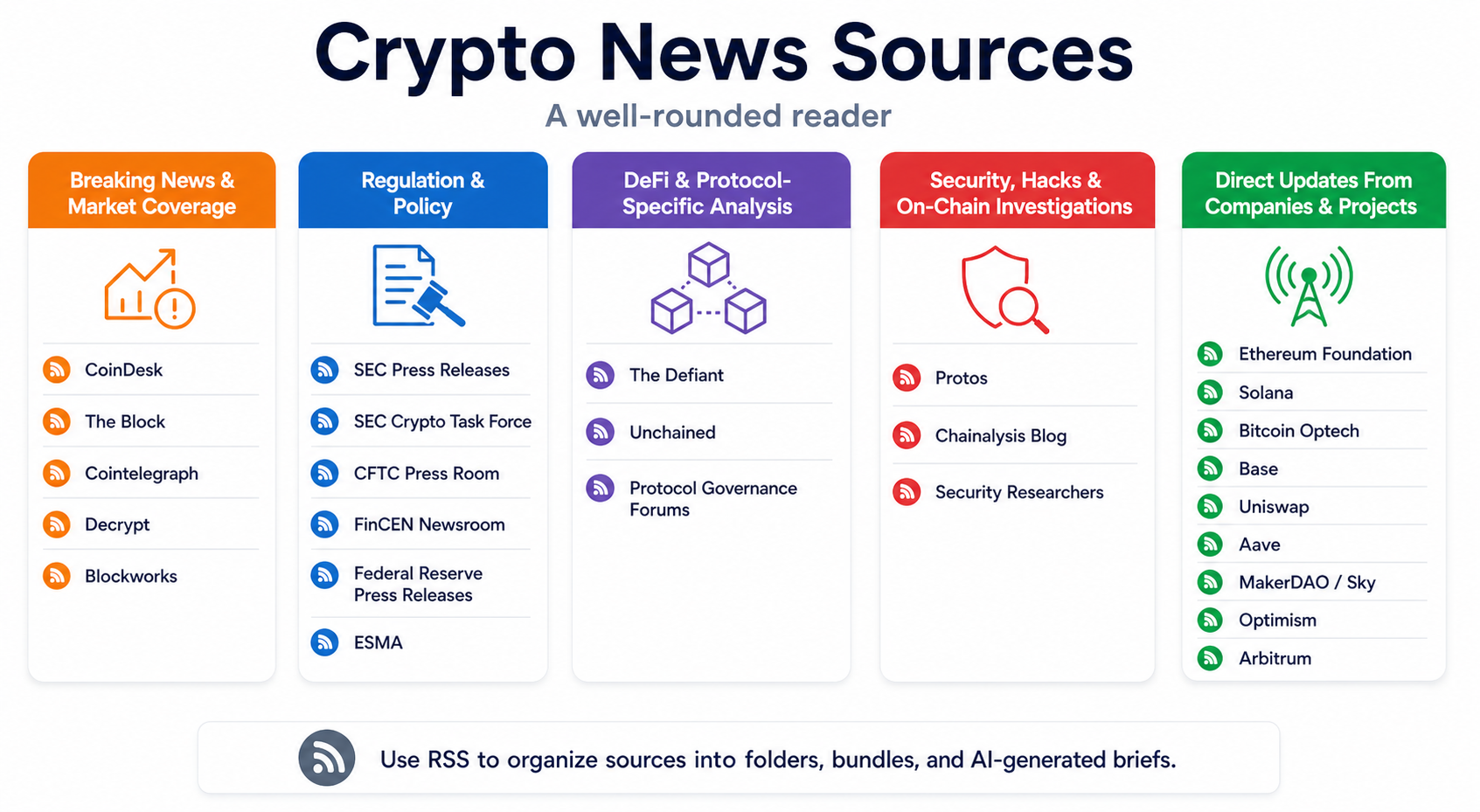
A well-rounded crypto reader usually covers five things:
- Breaking news and market coverage
- Regulation and policy
- DeFi and protocol-specific analysis
- Security, hacks, and on-chain investigations
- Direct updates from the companies and projects themselves
RSS is a good fit here because each of those can live in its own bundle, Telegram channel, or AI-generated brief. You're not really building one feed. You're building a monitoring system, just a lighter one than that sounds.
The general news sources
1. CoinDesk
CoinDesk is still one of the safest default adds for any crypto reader. It covers Bitcoin, Ethereum, markets, policy, institutions, exchanges, mining, and ETFs, with a solid mix of breaking news, explainers, and opinion pieces.
It's broad by design, so on its own it won't give you much depth on DeFi or niche ecosystems, but as a baseline source, it's hard to beat.
Good for: investors, founders, analysts, and anyone who wants a reliable top-level view of the industry.
2. The Block
Think of The Block as CoinDesk with a sharper focus on market structure. It's especially strong on exchange news, funding rounds, stablecoins, ETFs, and the business side of crypto, the stuff behind the headlines.
Some of its deeper research and data lives behind a paywall, so treat the free RSS feed as a great way to catch headlines and discover stories, not a full research subscription.
Good for: analysts, operators, investors, and anyone tracking the companies behind the markets.
3. Cointelegraph
Cointelegraph publishes a lot. If your goal is raw coverage density, breaking news, altcoins, regulation, and blockchain infrastructure, it's one of the best sources to have.
That volume is also the catch. It's easy to let Cointelegraph flood a general feed, so it's worth pairing with keyword filters (Bitcoin, ETF, SEC, Ethereum, exploit, whatever actually matters to you) instead of dropping it in raw.
Good for: readers who want breadth and speed above all else.
4. Decrypt
Not every crypto reader needs to feel like a Bloomberg terminal. Decrypt covers crypto, Web3, gaming, and culture in a more accessible, readable style, and it's especially good at catching stories that cross into consumer apps, NFTs, and mainstream tech.
If you're building a purely institutional or trading-focused feed, Decrypt might feel a little too broad. But if you care about where crypto touches actual users, it earns its spot.
Good for: marketers, product teams, creators, and anyone who wants crypto news that isn't only about markets.
5. Blockworks
Blockworks leans institutional: research, podcasts, events, and commentary aimed at professional investors. It's a strong source for ETFs, macro, tokenization, and market structure.
In 2026, it is better described as a data, research, and content layer than a pure daily news source, so pair it with a faster breaking-news feed.
Good for: institutional investors, analysts, and operators who think about crypto as a financial market first.
The DeFi-native sources
6. The Defiant
Another strong DeFi-native pick, especially for decentralized exchanges, liquid staking, restaking, and Ethereum ecosystem news. If your reader has a DeFi folder, The Defiant belongs in it, ideally alongside a general news source rather than instead of one.
Good for: DeFi users, builders, and researchers watching protocol-level developments.
The context and investigation layer
7. Unchained
Some crypto stories can't really be understood from a headline. A regulatory shift, an exchange collapse, an ETF flow story, they need room to breathe. Unchained's long-form interviews and explainers give you that room.
It's not always the fastest source for breaking news, so think of it as your context layer rather than your newswire.
Good for: founders, investors, and anyone who wants the "why," not just the "what."
8. Protos
A good crypto reader shouldn't only track bullish narratives, it should also track risk. Protos covers investigations, scams, exchange controversies, and the uncomfortable stories other outlets sometimes soften.
Its editorial angle is sharper and more skeptical than most general news sources, which is exactly why it's worth having alongside them, not on its own.
Good for: compliance teams, risk teams, and anyone who wants a built-in dose of skepticism.
9. Chainalysis Blog
Security and crime stories in crypto often turn into market stories later. Hacks, sanctions, laundering patterns, bridge exploits, they move fast, and blockchain analytics sources like Chainalysis often see them before general news does.
It's not a general newswire, so use it as a specialized risk and compliance layer rather than your main feed.
Good for: compliance teams, security teams, and exchanges tracking crypto risk.
Primary sources: projects, protocols, and regulators
The best crypto news often doesn't start on a news site at all. It starts on a project blog, a governance forum, a GitHub release, or a regulator's press page, and by the time it reaches a headline, it's already old news to the people who were watching directly.
Worth adding if you follow specific ecosystems:
- Ethereum Foundation Blog
- Solana Blog
- Bitcoin Optech
- Base Blog
- Uniswap Blog
- Aave Governance
- MakerDAO / Sky Forum
- Optimism Governance
- Arbitrum Governance
These are primary sources, not neutral analysis. A project blog tells you what the project wants to announce, not necessarily what matters most, so pair them with news coverage rather than relying on them alone.
Worth adding if regulation affects you (and in 2026, it probably does):
- SEC Press Releases
- SEC Crypto Task Force
- CFTC Press Room
- FinCEN Newsroom
- Federal Reserve Press Releases
- European Securities and Markets Authority
Official sources aren't written for easy reading, they're written for compliance, which is exactly where an AI summary or keyword filter earns its keep.
Good for: builders and developers tracking specific chains (project blogs) and legal, compliance, and fintech teams who need to know the moment rules change (regulators).
A simple starting stack
If you're building this from scratch, don't add 80 feeds on day one. Start smaller:
- Crypto News: CoinDesk, The Block, Cointelegraph, Decrypt
- Markets & Institutions: Blockworks, Unchained, a couple of newsletters or analyst blogs you trust
- DeFi: The Defiant, plus governance forums for the protocols you actually use
- Risk & Security: Protos, Chainalysis, a security researcher or two
- Regulation: SEC, CFTC, FinCEN, plus your regional regulator if you're outside the US
That's enough to see the market from a few different angles without turning your reader into a source of anxiety.
The part that isn't really about "sources" anymore
Here's the catch with a list like this: not everything on it behaves like a normal blog.
Some sites have clean RSS feeds. Some have several. And a lot of the good stuff, X accounts, Telegram channels, Reddit communities, YouTube channels, governance forums, doesn't publish RSS at all, even though it's often where the fastest signal actually shows up.
That's the gap RSS.app fills. You can generate a feed from pretty much any of those, news sites, X profiles, Reddit threads, Telegram channels, YouTube channels, governance forums, and pull all of it into one reader instead of bouncing between six apps.
And once it's all in one place, you're not stuck just reading it. You can embed a live crypto feed on a site, push alerts into Slack or Discord, publish updates to a Telegram channel, or send an email digest.
If this still feels like too many sources
Honestly, that's fair. Crypto news isn't just fast, it's repetitive. Five outlets might cover the same ETF filing. Ten accounts might post the same exploit rumor within minutes of each other. The goal was never to read everything, it's to know what matters without refreshing six tabs all day.
That's what AI Brief is for. Instead of monitoring every source on this list individually, you can bundle them together and let AI Brief turn the noise into a short, recurring summary, delivered to Slack, email, Telegram, or wherever your team already looks.
If you want to see it built out step by step, this walkthrough shows exactly how to set one up:
The bottom line
No single source covers breaking news, DeFi research, regulatory shifts, and community sentiment equally well, and treating one outlet as a complete crypto news diet is how people miss the stories that actually matter. The better approach is a small, deliberate mix, organized by what each source is actually good at, filtered down to what's relevant, and summarized so it doesn't take an hour every morning to stay current.
And if this is for a team, don't stop at a reader. Turn it into a workflow: breaking news into Slack, regulatory changes into an email digest, market news on an internal dashboard, an AI Brief for execs, a Telegram feed for your community. Keep your own reader clean enough that you'll actually open it.
Crypto rewards people who catch things early. RSS makes the information easier to collect. RSS.app makes it easier to turn that collection into something you'll actually use.
Want to try RSS feeds?
Create your first feed in minutes. Free to start, no credit card required.
Share this article


Ready to get started?
Create your first RSS feed in minutes. No coding required.